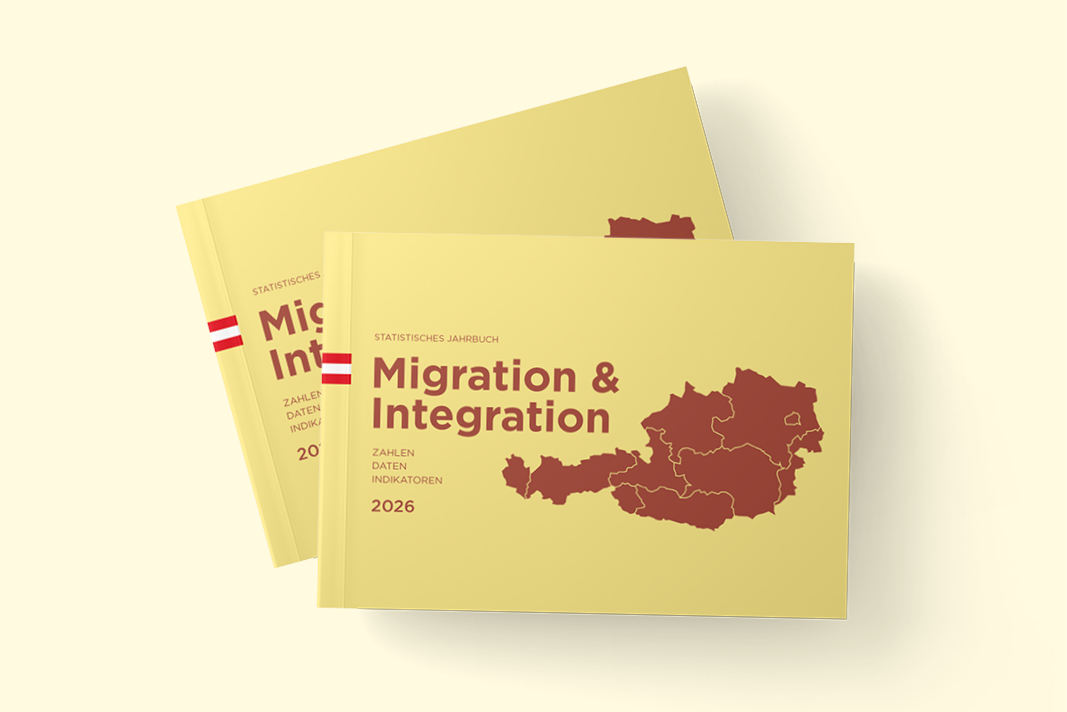
The new Statistical Yearbook "Migration & Integration" from Statistics Austria and the Austrian Integration Fund (ÖIF) compiles current data on population, education, employment, asylum, and immigration. The Statistical Yearbook is available for download in the ÖIF media library . Interactive graphics and data visualizations on figures, data, and facts related to asylum, migration, and integration are also available from the ÖIF at www.integrationsdaten.at .
The proportion of the population with a migration background rises to 28.2% /Net immigration will decline significantly again in 2025.
In 2025, an average of around 2.55 million people with a migration background lived in Austrian private households – 1.8% more than in the previous year. Their share of the population rose from 27.8% to 28.2%. Around three-quarters (1.90 million) belong to the so-called "first generation": they were themselves born abroad and immigrated to Austria. The remaining quarter (around 652,400 people) are Austrian-born descendants of parents born abroad ("second generation").
At the beginning of 2026, approximately 1.88 million foreign nationals were living in Austria. Their share of the total population increased from 20.2% to 20.4% compared to the previous year. Germans continued to form the largest group among foreign nationals: On January 1, 2026, around 242,300 German nationals were living in Austria, followed by 157,700 Romanians, 123,400 Turkish nationals, 122,500 Serbian nationals, and 115,200 Hungarian nationals. Nationals from Syria, Croatia, Bosnia and Herzegovina, Ukraine, and Poland ranked sixth through tenth.
Net immigration to Austria continued to decline in 2025: a total of approximately 161,900 people immigrated and 131,200 emigrated. This resulted in a net migration of around 30,700 people – compared to 50,100 in 2024 and 66,600 in 2023.
Asylum applications and asylum grants significantly decreased in 2025
With approximately 16,700 asylum applications, significantly fewer people sought asylum in Austria in 2025 than in the previous year (2024: 25,400). The majority of applications, around 12,500 (75%), were first-time applications, while approximately 4,200 were subsequent applications. Most asylum applications in 2025 were submitted by Afghan nationals with around 5,200 applications, followed by Syrian nationals with around 4,500 and Somali nationals with around 1,000 applications. The significant decrease compared to the previous year is primarily attributable to the reduced number of applications from Syrian nationals (2024: 13,900).
In 2025, approximately 8,400 people were granted asylum in Austria. This was about half the number granted in the previous year (2024: 17,000). Most positive asylum decisions were made for Afghan nationals, with around 4,800 recognitions, followed by Syrian nationals with around 1,300 and Somali nationals with around 700. In a European comparison based on Eurostat data and the asylum statistics of the Federal Ministry of the Interior (BMI), Austria ranked fifth among EU and EFTA states in 2025, with around 8,400 asylum recognitions. Subsidiary protection was granted to around 3,400 people in 2025 (2024: 7,800).
Large differences in labor force participation and unemployment
The employment rate of people with a migration background was 69% in 2025, around eight percentage points lower than that of the population without a migration background. It was particularly low for women with a migration background from Afghanistan, Syria, or Iraq, at 29%. At the same time, the employment rate of people from Afghanistan, Syria, or Iraq, based on their nationality, rose from 40% to 49% compared to the previous year.
Significant differences are also evident in unemployment figures: In 2025, the unemployment rate for Austrian citizens was 6.1%, while for foreign nationals it was 11%. It was particularly high for nationals from Afghanistan, Syria, and Iraq, at 28.9%. Overall, the number of unemployed increased by 6.6% to approximately 317,500, and the number of long-term unemployed rose by 25.4% to around 44,800. Participation in training programs, however, saw only a slight increase: by 1.2% for foreign nationals and by 1.4% for Austrian nationals.
44% of recipients of social assistance or minimum income support in 2024 were refugees or beneficiaries of subsidiary protection.
In 2024, approximately 205,800 people received social assistance or minimum income support (2023: 197,000). Of these, 38%, or 77,800 people, were Austrian citizens. A further 44%, or 91,300 people, were refugees or beneficiaries of subsidiary protection. Around 15,100 recipients, or 7%, were citizens of EU and EFTA states or the United Kingdom. A further 21,500 people, or 10%, were third-country nationals without asylum status or subsidiary protection.
The proportion of students with non-Austrian citizenship rises to 21%.
In the 2024/25 school year, 21% of students in Austria did not have Austrian citizenship. This represents an increase of one percentage point compared to the previous year. The proportion of students whose first language was not German remained unchanged at 26%.
The proportion of students with a non-German first language was particularly high in special needs schools (45%) and polytechnic schools (42%). The lowest proportions were recorded in vocational schools (11%), upper secondary vocational schools (just over 15%), and the lower grades of academic secondary schools (just under 18%).
Furthermore, students whose first language is not German are more likely to leave the school system without completing compulsory education: Around 9% of students whose first language was not German and who were already 14 years old at the beginning of the 2021/22 school year had still not completed compulsory education two school years later. For students whose first language is German, this figure was 3%.