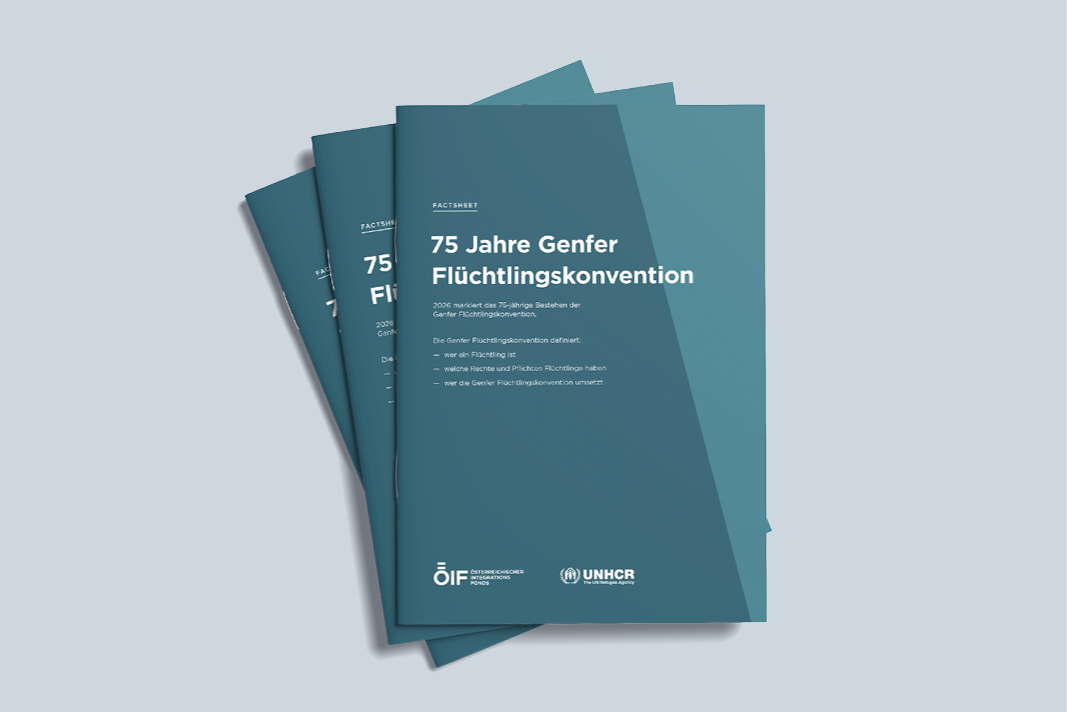
Asylum applications and asylum recognitions in Austria have declined significantly recently, following the record highs of previous years. To mark the 75th anniversary of the Geneva Refugee Convention, the Austrian Integration Fund (ÖIF) and the UN Refugee Agency (UNHCR) have published a joint factsheet with current figures and developments on displacement, asylum, and integration in Austria and worldwide. The factsheet is available for download on the ÖIF website.
Automatically translated with AI
This page was automatically translated using AI and serves as an additional aid and service. For legally binding content, please use the German page.
75 years of the Geneva Refugee Convention: Factsheet from ÖIF and UNHCR shows current developments on flight, asylum and integration
Asylum applications and asylum recognitions in Austria have recently declined significantly.
Worldwide, there are approximately 28.5 million refugees – two-thirds come from five countries of origin.
Since the adoption of the Geneva Refugee Convention 75 years ago, the number of refugees under UNHCR's mandate has risen significantly worldwide. While around 2.1 million people were registered as refugees globally in 1951, this number had reached approximately 28.5 million by 2025. Compared to 1951, the number of refugees under UNHCR's mandate in 2025 was more than 13 times higher. Around two-thirds of all refugees come from just five countries of origin: Ukraine (5.2 million), Syria (4.9 million), Sudan (2.8 million), Afghanistan (2.7 million), and South Sudan (2.4 million). The largest host countries were Germany (2.7 million), Turkey (2.4 million), and Uganda (1.9 million).
Eight out of ten refugees in Austria come from Syria, Ukraine, or Afghanistan.
In 1951, approximately 282,000 refugees were living in Austria under the UNHCR mandate. After a significant decline in the following decades, the numbers rose again as a result of refugee movements since 2015 and, in particular, the war in Ukraine. By 2025, around 286,700 refugees were living in Austria under the UNHCR mandate; the most frequent countries of origin were Syria (35%), Ukraine (32%), and Afghanistan (16%).
Asylum applications and asylum recognitions have recently declined significantly.
After peaking at 112,300 asylum applications in 2022, the numbers in Austria declined significantly. Around 16,700 asylum applications were registered in 2025. Most applications came from people from Afghanistan (5,200), Syria (4,500), and Somalia (1,000). Together, these three countries of origin accounted for more than 60% of all asylum applications.
The number of positive asylum decisions has also fallen significantly in recent years. After approximately 17,300 asylum applications were approved in 2023, around 8,400 people were recognized as refugees in 2025. More than 80% of the positive decisions were for people from Afghanistan, Syria, and Somalia. The proportion of women among those granted asylum reached its highest level since 2014 in 2025, at 54%.
About the Geneva Refugee Convention
The Geneva Refugee Convention was adopted on July 28, 1951, and remains the central foundation of international refugee law. It defines who qualifies as a refugee, what rights and obligations refugees have, and who is responsible for their implementation. The Convention governs the treatment of individuals who are outside their country of origin owing to a well-founded fear of persecution. The Convention cites race, religion, nationality, membership of a particular social group, or political opinion as grounds for persecution. Originally, the Convention focused primarily on European refugees as a consequence of the Second World War. The 1967 Protocol broadened its scope both temporally and geographically. Today, 149 states are party to the Geneva Refugee Convention and/or the 1967 Protocol.
About the Austrian Integration Fund
The Austrian Integration Fund (ÖIF) was established in 1960 by the UN Refugee Agency (UNHCR) and the Austrian Federal Ministry of the Interior under the name "United Nations Refugee Fund." Since 1998, the ÖIF has been responsible for integration assistance under the Asylum Act, and since 2017 for the comprehensive implementation of integration measures under the Integration Act. Since 2021, the ÖIF has coordinated state-funded German language courses for refugees and beneficiaries of subsidiary protection throughout Austria, and since the outbreak of the war in Ukraine, also for displaced persons from Ukraine.