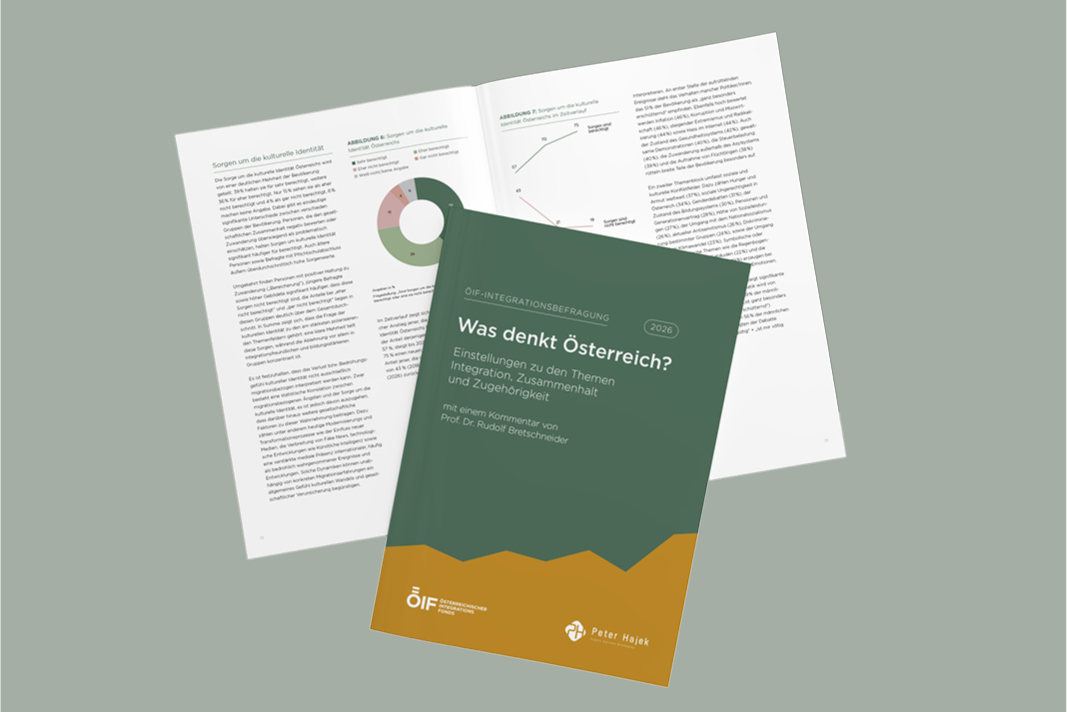
How is the state of Austrian society assessed? What exactly is meant by integration? What expectations does Austrian society have of immigrants? A new survey conducted by pollster Peter Hajek, with a foreword by social scientist Prof. Rudolf Bretschneider, commissioned by the Austrian Integration Fund (ÖIF), examines the attitudes of the Austrian population towards social cohesion, migration, and integration. The research report is now available in the ÖIF media library .
Integration through shared rules, values, language and autonomy
From the respondents' perspective, key characteristics of successful integration include acceptance of laws and regulations (77%), respect for values and customs (75%), good German language skills (71%), employment or training (70%), and self-sufficiency (69%). Priorities vary depending on attitudes toward migration: While those who are more critical of migration primarily emphasize linguistic, legal, and labor market-related obligations, those who are supportive of migration often place greater importance on social and cultural aspects such as involvement in clubs and associations or openness. The main integration problems perceived are unemployment and reliance on social welfare (89%), rejection of Austrian culture and values (89%), insufficient German language skills (89%), and honor-based violence and a lack of respect for women (90%).
Concerns about Austria's cultural identity have risen significantly.
A growing majority of those surveyed consider concerns about Austria's cultural identity to be justified: since 2018, this figure has risen from 57% to 75%. According to social scientist Professor Bretschneider, however, migration is not the only decisive factor; modernization pressures, media changes, and international crises also play a role. This aligns with the fact that large-scale migration movements are now perceived as a negative societal influence (51%), ranking slightly behind misinformation (54%), political Islam (52%), and global wars and conflicts (52%). Compared to 2018, concerns about large-scale migration movements have decreased significantly, from 62% to 51%.
Divided views on social cohesion /Three-quarters are worried about social development
According to a survey, the state of social cohesion in Austria is perceived differently: While 48% rate it as very or rather good, roughly the same percentage see it as rather or very poor. More positive assessments come particularly from younger people, those with higher levels of education, and people with a migration background. Respondents primarily define social cohesion in terms of peaceful coexistence (69%), tolerance and respect (66%), and helpfulness and charity (52%). While 75% of respondents are concerned about the development of Austrian society, an equal number (75%) report being satisfied with their personal lives. The fact that technological developments are also increasingly viewed critically is particularly evident in the sharp rise in the perceived negative impact of digitalization and artificial intelligence (from 14% to 28%) since the first survey in 2018.
Personal experiences are predominantly positive, while societal impacts are viewed more critically.
Most respondents rate their personal experiences with migrants as predominantly positive, depending on the area of life. Among friends and acquaintances, 73% report positive experiences; at schools, training institutions, or universities, this figure rises to 70%; at the workplace, to 62%; and in their neighborhood, to 58%. At the same time, the overall societal impact of immigration is viewed rather critically, particularly with regard to the social welfare system (50%), public safety (47%), the education system (45%), the housing market (41%), and social cohesion (35%). Positive impacts are most frequently perceived in the areas of research (24%) and culture and population development (both 21%).
In general, the greatest potential for social tension is seen between natives and immigrants (56%), followed by left and right (50%) and rich and poor (40%). 61% of respondents fully or somewhat agree with the statement that they feel more comfortable in a society characterized by high uniformity (homogeneous society) (16% fully agree and 45% somewhat agree). At the same time, the proportion of those who feel very or somewhat part of Austrian society differs only by one percentage point between people with and without a migration background, from 57% to 58%. However, significantly more people with a migration background (14%) than without (7%) feel marginalized in society.
About the survey
The Austrian Integration Fund (ÖIF) research report, entitled "What Does Austria Think?", was conducted for the fourth time under the editorial direction of Prof. Bretschneider on behalf of the ÖIF. Based on a representative online survey conducted between February and March 2026, the report analyzed the attitudes of the Austrian resident population regarding integration and immigration. The 2026 survey included 1,016 individuals with and without a migration background, interviewed via an online panel.