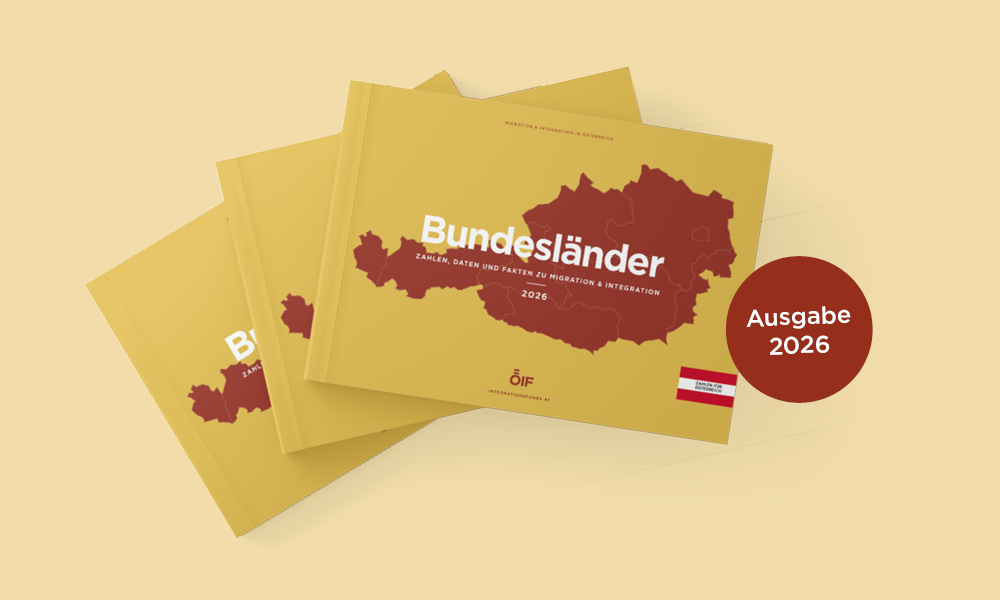
Around 2.1 million people in Austria were born abroad, representing almost one in four (22.9%). This figure has increased by 4.6 percentage points compared to 2016. This is shown in the new statistical brochure "Federal States 2026" published by the Austrian Integration Fund (ÖIF). The annual publication provides an overview of current figures and developments regarding migration and integration in all nine federal states. The focus is on origin, immigration and emigration, employment, unemployment, education, and birth rates, as well as regional differences over the past ten years. The brochure is available for free download on the ÖIF website.
Automatically translated with AI
This page was automatically translated using AI and serves as an additional aid and service. For legally binding content, please use the German page.
New ÖIF federal state brochure 2026: Around 23% of Austria's population were born abroad
The Austrian Integration Fund (ÖIF) publishes available figures on origin, immigration, employment, education and birth trends in all nine federal states.
41.3% of Vienna's population was born abroad – an increase of 6.8 percentage points in ten years.
Most foreign-born people in Austria have Germany (275,500), Bosnia and Herzegovina (181,200), or Turkey (166,600) as their country of birth. The proportion of foreign-born residents is particularly high in Vienna: at the beginning of 2026, around 841,900 foreign-born people lived in the capital. This corresponds to 41.3% of Vienna's population and represents an increase of 6.8 percentage points since 2016. After Vienna, Vorarlberg (23.7%) and Salzburg (22.2%) recorded the highest proportions, while Burgenland (13.9%) had the lowest. Over the past ten years, Vienna saw the strongest increase in the proportion of foreign-born residents, rising by 6.8 percentage points, followed by Styria (+4.2%), and Salzburg and Tyrol (both +4.1%). The smallest increases were in Lower Austria (+2.9%) and Burgenland (+3%). In 2025, approximately 161,900 people immigrated to Austria from abroad, 16,700 fewer than in the previous year. At the same time, the number of emigrants increased from 128,500 to 131,200. The net migration gain was therefore around 30,700 people.
How many people born abroad live in each federal state?
(Source: STATISTICS AUSTRIA, Statistics on natural population movement, Demographic indicators)
Employment rate of foreign nationals highest in Tyrol and Salzburg
The employment rate in Austria in 2025 was 74.3%. While 76.2% of Austrians were employed, the figure for foreign nationals was 68.3%. Significant regional differences were evident: Tyrol (76.5%) and Salzburg (75.1%) had the highest employment rates for foreign nationals, while Vienna had the lowest at 63.0%. The difference between Austrian and foreign nationals was particularly pronounced in Burgenland (74.4% compared to 64.6%) and Styria (76.3% compared to 66.5%).
Significant differences also exist in unemployment rates: In 2025, the unemployment rate for foreign nationals across Austria was 11%, while for Austrian nationals it was 6.1%. The highest unemployment rates among foreign nationals were recorded in Vienna (17.1%), Styria (10.3%), and Carinthia (9.4%). The lowest rates were in Burgenland (5.4%) and Tyrol (6.1%).
The proportion of students with special educational needs is highest in Vienna.
In the 2024/25 school year, there were approximately 50,800 students with special educational needs across Austria, representing 4.4% of all students. The highest percentages were recorded in Vienna (7.8%) and Upper Austria (4.5%), while the lowest were in Burgenland (2.1%) and Carinthia (2.5%). Overall, 26% of Austrian students had a first language other than German, an increase of 3.8 percentage points compared to 2014/15. The distribution varied considerably between school types: Special needs schools and polytechnic schools had particularly high percentages of students with a non-German first language, at 44.6% and 41.5%, respectively. The percentage was also above average at middle schools (34.9%). In contrast, 18.9% of students at vocational middle schools (BMS) and 15.4% at higher vocational schools (BHS) had a first language other than German. The lowest percentage was recorded at vocational schools (9.4%). In a comparison of the federal states, the proportion of pupils with a non-German first language was highest in Vienna at 48.9% and lowest in Carinthia at 16.7%.
What percentage of students are considered to have special educational needs in each district?
(Source: STATISTICS AUSTRIA, Statistics on natural population movement, Demographic indicators)
The average number of children in Austria has fallen to 1.3 – for women from Afghanistan, Syria and Iraq it is 3.37.
The average number of children per woman in Austria has continued to decline: while it was 1.49 in 2015, it was only 1.30 in 2025. There are significant differences depending on the woman's country of birth. For women born in Austria, the average number of children was 1.19, while for women born abroad it was 1.57. The latter group also saw a significant decrease compared to 2015 (1.92). The average number of children was particularly high for women from Afghanistan, Syria, and Iraq, at 3.37. Women from the successor states of Yugoslavia had an average of 1.92 children. For women from EU member states before the 2004 enlargement, the figure was 1.08, which is lower than that of women born in Austria.
About the ÖIF brochure
The new statistical brochure "Federal States 2026" from the Austrian Integration Fund (ÖIF) provides current figures, data, and facts on origin, immigration and emigration, employment, unemployment, income, education, and birth rates in all nine Austrian federal states. The publication highlights regional differences and key developments over the past ten years. It is based, among other sources, on data from Statistics Austria and the Public Employment Service (AMS). The brochure is available for free download on the ÖIF website. Further current figures, as well as interactive graphics and data visualizations on asylum, migration, and integration, are available from the ÖIF at www.integrationsdaten.at .