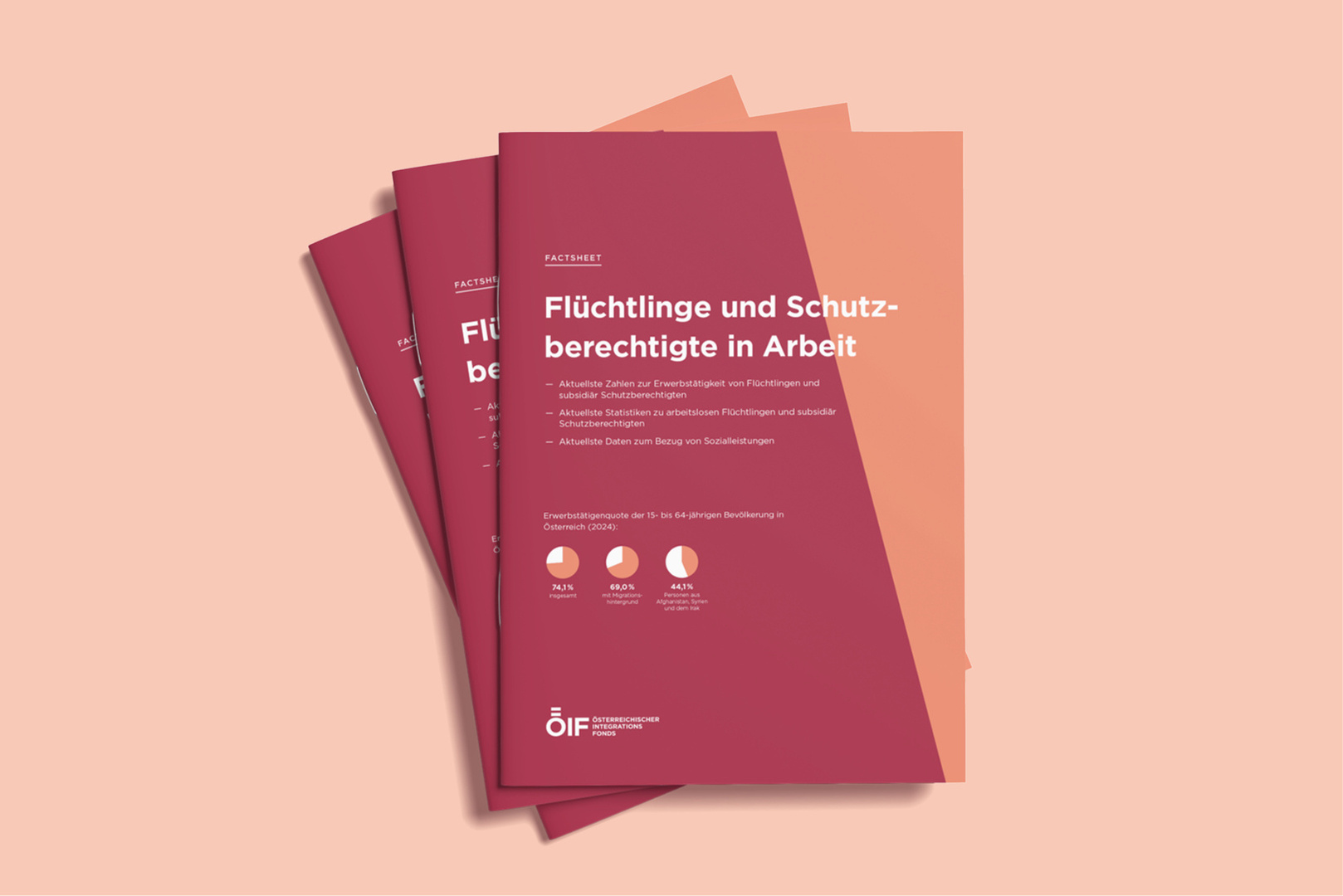
How successful are refugees in Austria at finding employment? What differences emerge based on gender, federal state, and country of origin? And in which sectors do refugees find the best foothold? The new ÖIF factsheet, "Refugees and Beneficiaries of Protection in Employment,"provides answers to these questions. The factsheet compiles the latest available figures, data, and facts on employment, unemployment, and social benefit receipt among refugees and beneficiaries of subsidiary protection. The new factsheet is available for free download in the ÖIF media library.
Automatically translated with AI
This page was automatically translated using AI and serves as an additional aid and service. For legally binding content, please use the German page.
New ÖIF factsheet: Almost one in four women from Syria, Afghanistan and Iraq is employed
Unemployment among beneficiaries of subsidiary protection is falling significantly, while unemployment among female refugees remains stagnantly high / Facts and figures on the topic of work
People from countries of origin of refugee migration work primarily in the catering, trade and industry sectors.
In 2025, an average of approximately 82,000 people from the six countries of origin with the most asylum and subsidiary protection grants (Syria, Afghanistan, Somalia, Russia, Iran, and China) were employed in Austria. At the same time, an average of around 44,000 refugees and beneficiaries of subsidiary protection were registered as unemployed or in training in 2025; this figure was around 37,000 in June 2026. In 2025, people from the six most frequent countries of origin for refugee migration primarily worked in the accommodation and food service sector (15,500), retail (12,000), and manufacturing (10,100). Other important employment sectors included other business services (9,900), transportation and warehousing (6,700), and the health and social services sector (5,200).
Women from Afghanistan, Syria and Iraq are significantly less likely to be employed.
In 2024, the employment rate for people with a migration background was 69%, compared to 76% for the population without a migration background. It was significantly lower for people from Afghanistan, Syria, and Iraq: on average, 44% of this group were employed. The employment rate for women was particularly low at just 24%, while 56% of men from these countries of origin were employed. This puts the employment rate for this group significantly below the average for both people with and without a migration background. By comparison, the employment rate for people with a migration background from Turkey was 64%, and for people from the states of the former Yugoslavia (non-EU), it was 72%.
At the same time, there are clear differences in unemployment rates: While the overall unemployment rate in Austria was 7.4% in 2025, it was around 33% for Syrians, 30% for Somalis, and 23% for Afghans. Among women, the figures were significantly higher: The unemployment rate for Syrian women was around 43%, for Somali women 40%, and for Afghan women 37%.
Compared to the same month of the previous year, June 2026 shows a particularly significant decrease in unemployment among beneficiaries of subsidiary protection (-30%), while it fell by 10% among refugees. Unemployment among male refugees decreased by 17%, while it remained largely unchanged among female refugees, with a slight increase of 0.6%.
Significant regional differences exist in unemployment and social assistance receipt among refugees.
In June 2026, approximately 37,000 refugees and beneficiaries of subsidiary protection were registered as unemployed or participating in training. The annual average for 2025 was 44,000 people, the majority of whom came from Syria (55%), Afghanistan (19%), and Russia (5%). Vienna recorded the highest proportion of unemployed refugees and beneficiaries of subsidiary protection or those in training (16 per 1,000 inhabitants), followed by Vorarlberg (3.2) and Styria (2.2). The lowest rates were found in Carinthia and Lower Austria (1.1 each) and Burgenland (0.6).
Significant regional differences are also evident in the receipt of social assistance: Of the approximately 95,600 refugees or beneficiaries of subsidiary protection who received social assistance or minimum income support in 2025, around 73,400 lived in Vienna. Approximately half of all Viennese social assistance recipients in 2025 were refugees or beneficiaries of subsidiary protection. Nationwide, around 10.4 refugees or beneficiaries of subsidiary protection per 1,000 inhabitants received social assistance or minimum income support; in Vienna, the figure was significantly higher at 36.2 people per 1,000 inhabitants. This is a considerable difference compared to the next highest federal states: Vorarlberg (7.3) and Tyrol (6.6), as well as Styria (4.2) and Salzburg (3.3). The lowest figures were recorded in Carinthia (1.8), Upper Austria (1.6), and Burgenland (1.3). At the end of 2025, Vienna and Tyrol ended the entitlement of beneficiaries of subsidiary protection to social assistance or minimum income support. Since 2026, this group of people has only received basic social security benefits.
Refugees and beneficiaries of subsidiary protection receiving minimum income support and social assistance by federal state
per 1,000 inhabitants, in the year 2025
About the ÖIF factsheet
The new Austrian Integration Fund (ÖIF) factsheet, "Refugees and Beneficiaries of Protection in Employment," provides the latest available figures, data, and facts on employment, unemployment, and social benefit receipt among refugees and beneficiaries of subsidiary protection in Austria. It is based on data from Statistics Austria, the Public Employment Service (AMS), the Federal Ministry of the Interior, the Austrian Integration Fund, and the umbrella organization of social security institutions. The factsheet analyzes, among other things, employment rates, industry distributions, unemployment rates, regional differences, and trends in social benefit receipt. It also presents findings from current studies on the labor market integration of refugees and beneficiaries of subsidiary protection. Further current figures, data, and facts on asylum, migration, and integration in Austria, as well as interactive graphics and data visualizations, are available from the ÖIF at www.integrationsdaten.at.
ÖIF offers a wide range of integration services for refugees and displaced persons.
The Austrian Integration Fund (ÖIF), a fund of the Republic of Austria established under the Integration Act, is the central point of contact for asylum seekers, beneficiaries of subsidiary protection, and Ukrainian displaced persons regarding integration and German language learning. The ÖIF provides counseling, values and orientation courses, German language courses, and integration measures. With German courses offered during off-peak hours and on weekends, its own online German courses, and a range of online German learning resources on sprachportal.at, the ÖIF offers refugees, beneficiaries of subsidiary protection, displaced persons, and immigrants a comprehensive program for learning German alongside their jobs, promoting a rapid entry into the workforce while simultaneously learning German.