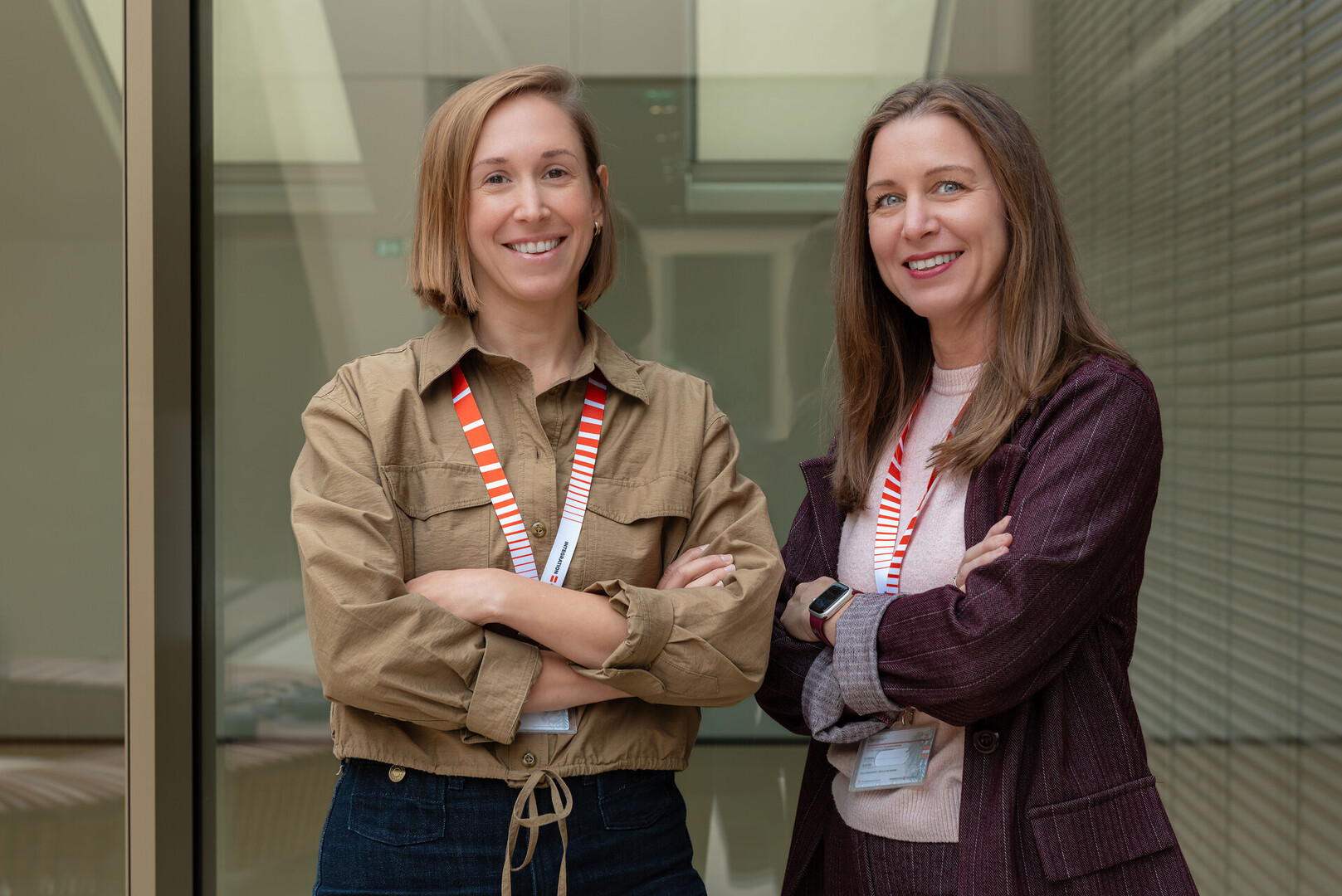
Two managers, two daughters aged two and twelve, and a shared responsibility: Barbara Stewart and Julia Rothbauer jointly lead the team “Wissensmanagement und Internationales” at the Austrian Integration Fund (ÖIF). The co-leadership model allows them to take on leadership responsibilities while also having time for their families. In this interview, they explain how they share tasks and decisions, what facilitates their collaboration, and where balancing work and family life remains challenging, even with good organization.
What factors influenced your decision to take on a leadership role – especially with regard to your family?
Barbara Stewart: “I have been with the Austrian Integration Fund (ÖIF) for 16 years and have already taken on leadership responsibilities as Julia’s deputy. The move to co-leadership after her return from maternity leave was therefore a further development of our proven collaboration. It was important to me to be able to fulfill the role well and at the same time have enough time for my daughter. Even though she is already more independent at twelve, I want to be involved in her daily life and be there for her. The fact that Julia and I have worked well together for ten years and can rely on each other gave me confidence in making this decision.”
Julia Rothbauer: “During my maternity leave, I naturally focused on how I would successfully return to my leadership role. It was important to me to continue taking on responsibility and to meet my own high standards for good leadership, as well as the expectations of my superiors and my team. I think one of the most difficult questions is how to ensure that neither professional responsibilities nor family life suffer. Furthermore, it was important to me to provide the team with the greatest possible stability and continuity in leadership. The co-leadership model was therefore an excellent solution for me. It was particularly important to me that Barbara and I have already worked closely and trustingly together for many years. I knew that we complemented each other well both professionally and personally and could share responsibility. This made my return to work a positive experience.”
What does joint leadership enable you to do personally? Is there a specific situation from your daily life where this becomes particularly clear?
Julia Rothbauer & Barbara Stewart: “Our daughters are two and twelve years old – so we're at different stages of family life. But even as the children get older, it remains important to have time for them and be involved in their daily lives. Sharing the management allows us to take on professional responsibilities while also being there for our daughters. If a work appointment clashes with a family commitment, we coordinate and can cover for each other. This gives us security – we know we can rely on each other.”
How do you organize responsibilities, availability, and mutual coverage so that you can rely on each other and plan family time?
Barbara Stewart & Julia Rothbauer: “We were able to build on the division of tasks we already had as head and deputy. Each of us has her own areas of expertise, while simultaneously keeping each other informed. This way, team members know who to contact with which issue, and we can easily cover for each other when someone is absent. We coordinate appointments and our availability as far in advance as possible. After ten years of working together, many things are well-established. Nevertheless, it's important to make conscious agreements and to address any changes openly. Another advantage of co-leadership, in our view, is that we can exchange ideas on important decisions and contribute different perspectives. This benefits not only the two of us, but also the team.”
Where does work-life balance remain challenging despite good organization – and what kind of support is crucial in these situations?
Julia Rothbauer & Barbara Stewart: “Things get challenging when work demands coincide with an unexpected family event. Regardless of age, with children there are always situations where you're needed at short notice. This can't always be planned in advance. Flexible arrangements and supportive people – within the team, among colleagues, and also from superiors – are invaluable in these situations. For us, it's crucial to be able to openly acknowledge when things are getting tight and find a solution together. The option of working from home can also make things much easier.”
What advice would you give to other women who aspire to a leadership position and are wondering how to reconcile it with their family situation?
Julia Rothbauer & Barbara Stewart: “We would advise other women to have confidence in themselves and to discuss early on what kind of framework they need and whether it is feasible. Good planning is crucial. At the same time, there are always scheduling changes and unforeseen events – therefore, one must remain flexible. For this to work in everyday life, however, the acceptance and support of superiors, colleagues, and the team are essential.”
For successful co-leadership, we believe that open communication and mutual trust are essential. When working so closely together, it also helps to get along well on a personal level. And for us, humor is absolutely crucial. Sharing responsibility is one of our strengths: We both contribute our experience and enable each other to pursue our careers and be there for our families.
Reconciling career and family: ÖIF focuses on family-friendly working conditions and development opportunities
The Austrian Integration Fund (ÖIF) implements targeted measures to make it easier for employees to balance work and family life and to enable professional development alongside family responsibilities. Since 2021, the ÖIF has been awarded the state-recognized "berufundfamilie" (work and family) seal of approval, and the certification was renewed in 2024. These family-friendly measures include meetings for employees on parental leave, a nationwide family day, and the option of bringing children to work in emergency situations.
That women at the Austrian Integration Fund (ÖIF) take on professional responsibility and utilize development opportunities is also reflected in the figures: 66 percent of employees and 57 percent of managers are women. Since 2022, the ÖIF has been specifically promoting the professional development of its employees through a mentoring program and a junior management program. Flexible work arrangements and family-friendly policies contribute to making it possible to reconcile career development, assuming leadership roles, and family responsibilities.